 Botanical name: Laurus nobilis Linn.
Family name: Lauraceae
Indian name: No information available.
English names: Bay, Laurel leaves, Sweet bay, True laurel.
In India this spice is often confused with `Tejpatra` a popular spice in India. This is so because the Europeans when they arrived confused between these two leaves and started calling Tejpatra as Laurel.
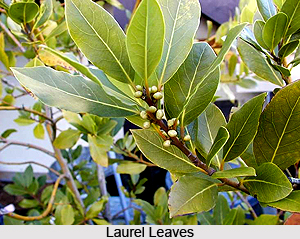
The surface color of the leaf is green; the underside is pale green and somewhat yellowish. Laurel leaves are used whole or cracked. The aroma of the crushed leaves is delicate and fragrant. The taste is aromatic and bitter.
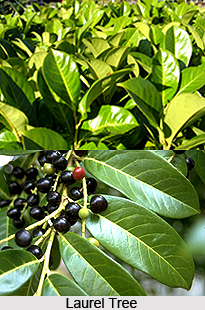
The sweet bay or laurel leaves originate from an evergreen hardy tree or bush cultivated since antiquity in Mediterranean countries. Size of leaves is variable, ranging from 2.5 to 7.5 cm or more in length and 1.6 cm to 2.5 cm or more in breadth at the widest part of the leaf. The shape of the leaf is elliptical, tapering to a point at base and tip of leaf.
The leaves, on steam distillation, yield 1 to 3 per cent essential oil with a characteristic sweet and spicy odor, reminiscent of cajuput. According to another report, fresh leaves and branch lets yield 0.5 per cent oil, while dried leaves yield about 0.8 per cent.
Dried berries of the tree, commonly called `bay berries` have been imported into India for medicinal use. The berry is ovoid [about 1.5 cm long], black, coarsely wrinkled and contains a single seed.
The composition of dried bay leaves is as follows:
Moisture:4.5 per cent
Protein:7.6 per cent
Fat:8.8 per cent
Fiber:25.2 per cent
Carbohydrates:50.2 per cent
Total ash:.7 per cent
Calcium:1.0 per cent
Phosphorus:0.11 per cent
Sodium:0.02 per cent
Potassium:0.6 per cent
Iron:0.53 per cent
Vitamin B1 [thiamine]:0.10 per cent
Vitamin B2 [riboflavin]:0.42 mg/100g
Niacin:2.0 mg/100g
Vitamin C [ascorbic acid]:46.6 mg/100g
Vitamin A:545 International units [I.U]
calorific value [food energy]:410 calories/100g.
 Bay or laurel leaves are among the world`s oldest herbs. The Greeks and Romans to honor their heroes used wreaths of laurel leaves. Laurel leaves are used principally in vinegar pickle when packing pig`s feet and lamb and pork tongue. They are also used in flavoring of soups, stews, meat and game dishes, fish and sauces, pickling, spice etc.
Both leaves and fruits possess aromatic, stimulant and narcotic properties and were formerly employed for hysteria, amenorrhoea and flatulent colic. They are even used internally, though rarely at the present time. Externally, however, commercial oil of laurel berry is sometimes applied as a stimulant in sprains. But its principal use is in veterinary medicines, which is still being applied.
The leaves are employed as a condiment and flavoring agent in foods and confectionary. The culinary uses are numerous. Laurel or bay leaves are available whole or cracked, are not usually ground, and are packed in bags. Therefore processing and packing is simple which can be done easily in villages with very low level of investment.
Laurel wood resembles walnut wood in grain and color and is suitable for decorative cabinetwork etc. Hence there is added advantage of this plant since it may help developing village level wood wok units wherever the cultivation is planned.