Introduction
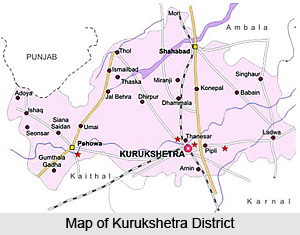 Kurukshetra District is an administrative district of Haryana. The district headquarter is located at Kurukshetra town and is about 160 kms north of Delh,i 39 kms north of Karnal and 40 kms south of Ambala. Kurukshetra District has an area of 1682.53 sq kms constituting around 3.8 percent of the total area of the state. Kurukshetra District lies between latitude 29 degree 52 minutes to 30 degree 12 minutes and longitude 76 degree 26 minutes to 77 degree 4 minutes in the north Eastern part of Haryana. The important towns of the district are Pehowa, Shahabad and Ladwa.Station, also called the Kurukshetra Junction, is located on main Delhi-Ambala Railway line.
History of Kurukshetra District
 History of Kurukshetra District suggests the origin of its name. The name Kurukshetra is associated in the India Puranas and Mahabharata with the legendary king Kuru although it appears to be more logical to trace it to the tribe of Kuru. Sarasvati River is described in the Rig Veda as a perennial river par excellence; flowing from the Himalaya Mountains to the ocean most probably it refers to the Ghaggar. Drsadvati River was the river in whose bed the Hansi-Hisar branch of the Western Yamuna Canal now flows.
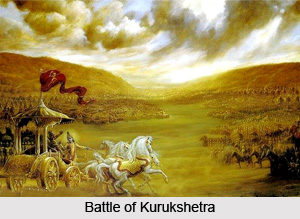
Many geographical names and personalities associated with Kurukshetra occur in the earliest Sanskrit literature. Further, according to the historical accounts most of the Vedic literature was composed here and most of the social, religious and political traditions of this country arose in this region. It is therefore regarded as the cradle of Indian civilisation and culture. Kurukshetra shot into prominence as the battle field of Mahabharata and as the birth place of the holy Bhagavad Gita. The great battle of Mahabharata was fought here in the ancient past between Kauravas of Mahabharat and Pandavas for upholding the cause of dharma. It was a war between good and evil, in which the Pandavas were victorious.
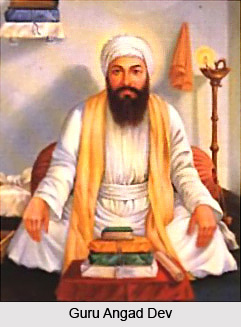
Jyotisar, near Thanesar, is supposed to mark the site where it was delivered. Kurukshetra is mentioned in ancient literature. A flourishing country of the Kurus, it was the most sacred region of the Dvapara age according to the Matsya Purana and one of the sixteen Mahajanapadas of Jambudvipa. History of Kurukshetra District also states that it was the region of lakes and lotus beds which can be seen even now. Manu indirectly praises the prowess of the people of Kurukshetra. Bana describes it as the land of the brave in the eyes of the warriors. The place was visited by Lord Buddha and appears to have been favoured by his masterly discourses. Kurukshetra also finds mention in Panini`s Ashtadhyayi. It was also visited by Guru Angad Dev.
Further, as per the history of Kurukshetra District, sons of the soil fought invaders in the battlefield of this sacred land from time to time and their exploits fill the pages of history. The period of King Harsha was a golden age. Kurukshetra District was initially a part of Karnal District. Kurukshetra District came into existence as a result of reorganization of Karnal district in 1973. The district however was again reorganized in 1989 giving birth to Kaithal district.
Geography of Kurukshetra District
On the whole, Kurukshetra District is a plain land which slopes from north east to south and south west. The plain is remarkably flat and within it, are the narrow low-lying flood plains, known as either Betre Khadar of Naili. Sarasvati, Markanda River and Ghaggar River are the important rivers of the district. A good network of canals is providing irrigational facilities. Underground water level is not relatively high. Tube well irrigation is also common in the district.
 The soil in the district is generally alluvial, loam and clay does not constitute average texture of the soil. The climate of Kurukshetra District is of pronounced character that is very hot in summer and markedly cold in winter. It is as high as 45 degree Celsius in summer and as low as 3 degree Celsius in winter.
Administration of Kurukshetra District
At present Kurukshetra district is divided into two Revenue Sub Divisions namely Thanesar and Pehowa. Thanesar Sub Division comprises Thanesar and Shahabad Tehsils and Ladwa, Babain Sub Tehsils. Pehowa Sub Division includes Pehowa Tehsil and Ismailabad Sub Tehsil. To cater development needs of the rural areas in the district, the district has been divided into five Community Development Blocks namely Thanesar, Ladwa, Shahabad, Babain and Pehowa. Three tier Panchayati Raj Institutions structure is in place to look after the development in rural areas with Zilla Parishad at district level, Panchayat Samities at each of the five Community Development Blocks and Panchayats at village level. 364 Panchayats are working for the development needs of 419 villages of the district. Kurukshetra District has four towns namely Thanesar, Shahabad, Ladwa and Pehowa where there are Municipal Councils for the development of these towns. Kurukshetra District falls under Kurukshetra Parliamentary Constituency and Deputy Commissioner, Kurukshetra is Returning Officer for this Constituency. The area of district Kurukshetra is spread in Thanesar, Shahabad, Pehowa, Nilokheri and Pundri Assembly Constituencies. The administrative work of the district is carried out by the various departments.
Economy of Kurukshetra District
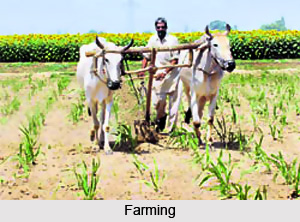 Economy of Kurukshetra District is primarily agrarian in nature. An overwhelming work force is engaged as cultivators and agriculture labourers in the district. Kurukshetra District enjoys an ideal location benefits being situated adjacent to national highway number 1. This district is coming up as an industrial belt and has started throbbing with the wide spectrum of developmental activities and unfolds immense potential of industrial opportunities.
Farming is the main occupation of the people as a sizeable percentage, that is over 90 percent of the people, is engaged in various agricultural pursuits. Wheat and rice are the main crops cultivated in Kurukshetra District. Among the commercial crops sugarcane is an important crop of this district. Cultivation of vegetables especially of potato is very popular in the district. To supplement the income, dairy farming and cattle rearing is another occupation adopted by the people of the district. These sectors are strengthening economy of the district. Most of the agriculturists are engaged in dairy farming, poultry farming, and pig farming, etc. as a side business. There are several milk plants in private sector in Kurukshetra.
Being an agriculture based economy, industrial set up in the district is also agro based, as there are a number of small and big rice and wheat processing units. A conscious attempt has been made by the District Industries Centre Kurukshetra to identify the small-large scale industry having scope in the district. The district also boosts of wide network of Commercial Bank branches. There are as many as 76 branches of various banks. Total geographical area of the district is 168253 hectares. The cultivated area is 150305 hectares, which is 89.3 percent of the total geographical area. The soils of Kurukshetra District are fairly fertile and leveled and are fit for every type of crop.
Animal Husbandry is an important sector constituting the economy of this district. It plays an important role for the upliftment of marginal farmers and landless agricultural laborers as it provides not only direct employment opportunity to them but also lessons pressure on agriculture as land holdings are diminishing day by day. As the economy of Kurukshetra District is entirely based on agriculture, the industrial scenario of this district is also influenced mostly by the same sector. This district has a number of small scale units having a fixed investment.
Fairs and Festivals of Kurukshetra
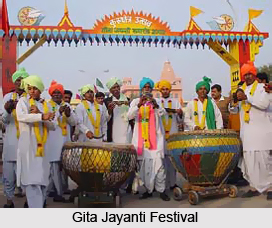 Fairs and festivals of Kurukshetra, Haryana involve a variety of colourful social occasions which are celebrated with gaiety by the regional inhabitants of this part of the country. Some of the most popular festivals of Kurukshetra are `Gita Jayanti`, `Chaitra Chaudas Mela` or `Pehowa`, `Somavati Amavasya`,ISKCON, Lord Jagannath Yatra, `Ratnawali` and solar eclipse.
Gita Jayanti
The birthday of the `Bhagavad Gita` is referred to as `Gita Jayanti` and it is holy book of the Hindus. This festive occasion is observed in Margaseersha month which falls between December and January, particularly on the 11th day of the waxing moon. It is said that Lord Krishna had revealed the Bhagavad Gita to Arjuna in the legendary battlefield of Kurukshetra above 5000 years ago. Therefore this festival is celebrated to commemorate the birth and creation of this immortal and divine text, in the northern Indian state of Haryana. It is also termed as the Kurukshetra festival, since it is held mainly at this historical place. During this festival, Kurukshetra is visited by innumerable pilgrims from all across India, who participate in the Gita Jayanti. Devotees take a ritual bath in the sacred waters of Brahma Sarovar and Sannihit Sarovar. Several kinds of rites, rituals and religious activities are performed in the Gita Jayanti. Organisations like Information and Public Relations Department, Haryana, Kurukshetra Development Board, North Zone Cultural Centre, Patiala and Haryana Tourism, District Administration organise the Gita Jayanti Samaroh.
Chaitra Chaudas Mela
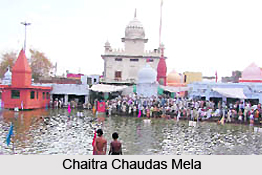
Every year, the Chaitra Chaudas Mela is arranged in March and it continues till April, on the banks of Saraswati Tirtha Pehowa. A vast number of devotees from different portions of India, especially Haryana and Punjab throng Kurukshetra to take part in Chaitra Chaudas Mela. They participate in significant rituals which involve offering water or `Tarpan` or offering food or `Pind Dan` to their deceased ancestors. It is believed that Pandavas used to perform these religious rituals following the battle of Mahabharata, for the purpose of peace of the souls who were all killed in the battle of Kurukshetra. If the Chaitra Amavasya falls on Monday, the importance of this festival multiplies manifold. The devotees take a holy dip in the holy waters of Saraswati Tirtha and then they proceed to take a bath in Sannihit Sarovar and Brahma Sarovar in the early hours of `Saumauti Amaawas`. Finally, they approach Haridwar to take a dip in Ganga River during the occasion of Kumbha Mela.
Somavati Amavasya
Somavati Amavasya refers to the time of `Amavasya` or the day of the new moon, or no moon`s day which falls on Monday of Somvar. The `Shanti Parva` of Mahabharata states that devotees who takes a dip in holy tanks and rivers during this auspicious day is blessed with peace, prosperity and a life devoid of ailments and anxieties. It is also said that if one takes a dip on this holy days, the soul of the deceased ancestors of the person would attain freedom. On the day when this festival is observed, lakhs of devotees pay a visit to this place, especially the `Tirthas` situated on the banks of Saraswati River. They take a bath in the waters of Sannihit Sarovar and Brahma Sarovar, as well as the tanks of Pandupindara and Ram Rai in Jind District, Haryana. `Maun Vrat` is observed during this day.
ISKCON Lord Jagannath Yatra
The Ratha Yatra is practiced traditionally in Puri, in the state of Orissa, where chariots known as `Rathas` are pulled through the streets to celebrate this festival. However, the Jagannath Ratha Yatra was started in Kuruskshetra for the first time by ISKCON in 1993.
Solar Eclipse
Kurukshetra is thronged by innumerable devotees every year during the time of solar eclipse who take a bath in Sannihit Sarovar and Brahma Sarovar. It is believed that taking a dip in the waters of these tanks would provide as much merit as might have been obtained on performing a thousand Ashawamedha Yajnas. People offer alms to the poor after following the rite of taking a dip in the sacred tanks.
Kurukshetra Mela
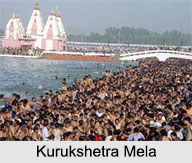 Kurukshetra Mela is celebrated chiefly in Kurukshetra, Haryana. The place of the Mela adds to the holiness of the event. Kurukshetra is the land where the heavenly `Bhagwad Gita` is believed to have been delivered by Lord Krishna to Arjuna. The place also holds the importance because famous Sage Manu wrote "Manusmriti" here. The "Rig Veda" and the "Sama Veda" were also composed here. Apart from Lord Krishna, the land was visited by celestial personalities like Gautama Buddha and well-known Sikh Gurus. Fairs are held during the solar and lunar eclipses at Kurukshetra.
Celebration of Kurukshetra Mela
During the Kurukshetra Mela, devotees and pilgrims from all over India meet at Kurukshetra. A ceremony is observed by every person is to take bath in holy water of the sacred tanks - "Sannihit Sarovar" and "Brahma Sarovar". The whole surroundings become heavenly and religious with several activities.
The weeklong Mela is celebrated with major attractions like "shloka recital", "dance performances", "Bhagwad Katha reading", "Bhajans", "Dramas", "Book Exhibitions" and "free Medical check-up camps". The Mela is organised by Kurukshetra Development Board, Haryana Tourism, District Administration, North Zone Cultural Centre Patiala and Information and Public Relations Department Haryana. Many people come here for the salvation on such occasions. Kurukshetra has been the germinating ground of the essence of Hinduism. It is one of the holy towns that have borne the imprint of Lord Krishna"s footsteps.
Visiting information of Kurukshetra Mela
Kurukshetra is well connected by roads with foremost cities of Haryana. The nearest airport is at New Delhi. Pehowa is 14.5 kms from Kurukshetra Railway station to reach Kurukshetra.
Tourism in Kurukshetra District
 Tourism in Kurukshetra District offers an enriching experience to the visitors. It gives the opportunity to explore its historical and religious sites. Kurukshetra District being the place of great historic and religious importance has been developed as a big tourist centre, which is visited by a number of travellers. Kurukshetra is one of the great pilgrimages for millions of devotees from all over the country who visit this sacred land. This is the venue of the great war of Mahabharata and the birth place of the Bhagavad Gita. Kurukshetra District is known for its several holy places. Through these sites, the travellers can get a glimpse of its rich historical and cultural traditions.
Tourism in Kurukshetra District includes several exploring opportunities like temples and tanks, connected with the ancient Indian traditions and Mahabharata war. It covers a wide area with the present Panipat and north-west corner of the Jind district in the south and eastern part of the Patiala district in the west, and the Sarasvati River and Yamuna River at its northern and eastern boundaries respectively.
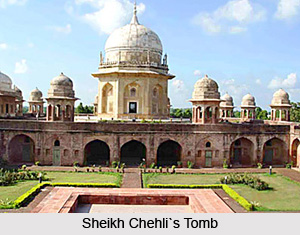 Kurukshetra District is considered as a tourist delight, and there are about 360 Tirthas of religious and historic significance. Out of these near about 134 tirthas are being maintained by Kurukshetra Development Board, Kurukshetra. The foremost among the Kurukshetra tirthas are Brahmasarovar or Kurukshetra Tank, Sannihit Tank, Sthaneshwar Mahadev Mandir, Jyotisar, Baan-ganga, Bhisam Kund (Narkatari) Chandrakupa, Nabhi Kamal, Bhadrakali Mandir, Arnai Temple, Prachi Tirath Pehowa, Saraswati Tirath Pehowa, Prithduk Tirath Pehowa, Rantuk Yaksh Bir Pipli, Karan Ka Tila, etc.
Pehowa town is an ancient in the district and it derives its name from Prithu who was called the first king. It is an ancient place of pilgrimage. The town contains two very popular tanks, one sacred to Lord Brahma and the other to the goddess Saraswati. Tourism in Kurukshetra District also includes few more sites of archaeological interest which have yielded various objects of antiquarian interest and a distinctive class of pottery known as the Painted Grey Ware. Some of the places of archaeological interest include Raja Karan Ka Tila, Asthipura, Bhor Saidan, Bhagpura and Daulatpur, etc. Apart from these places, the other places of historical interest connected with the medieval period of Kurukshetra District comprise an ancient fort and mounds, Sheikh Chehli`s Tomb and Madrasah, Pathar Masjid and Chini Masjid.
There is a museum in this district that is aimed at the awakening the people ethically, morally and culturally through the ideas and ideals of Lord Krishna. It was established in 1987. The gallery of this museum also preserves stone sculptures pertaining to Krishna legend ranging from 1st Century AD to 11th Century AD. All these places are worth visiting.
Pilgrimage Tourism in Kurukshetra District
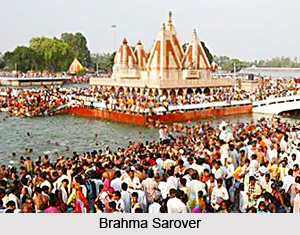 Pilgrimage tourism in Kurukshetra District comprises visits to several holy sites like temples, ponds and other religious sites. Kurukshetra District of Haryana is one of the most sacred places of the country. It is associated with the sermon of Lord Krishna to Arjuna and mankind in the form of the Bhagavad Gita. The holy town of Kurukshetra includes many holy temples and water tanks.
Some of the noteworthy pilgrimage tourist places of Kurukshetra District are as follows -
Brahma Sarover: The Brahma Sarover is a sacred water tank that is revered as the cradle of civilisation. It is a major centre of pilgrimage. The vicinity of the tank is marked by the presence of a number of small temples. Noteworthy among these are the small Mahadev temple (Sarveshwar Mahadev Temple) in the Sarover itself, Birla Gita Mandir, Baba Sharwannath`s Temple and Haveli. It is said that the beauty of the Sarover is distinct on Amavasya night. This place is associated sacred religious beliefs.
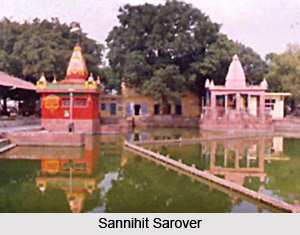
at the Sannihit Sarover is the meeting point of the seven sacred Saraswatis. Adjacent to this holy water tank there is are small temples of Dhruv Narain, Lord Vishnu, Laxmi Narain, Lord Hanuman and Goddess Durga.
 Sthaneshwar Mahadev Temple: Sthaneshwar Mahadev Temple at Thanesar is another holy centre of the district. This temple is dedicated to Lord Shiva. It was here that the Pandavas prayed to Lord Shiva and received his blessings for victory in the battle of Mahabharata. Legend has it that the water of the tank adjoining the temple is holy. No pilgrimage of Kurukshetra is believed to be complete without a visit to this holy temple. The tank and temple lie at a short distance from Thanesar town, which gets its name from this temple. It once formed an important part of the kingdom of the King Harshavardhan of the Pushyabhuti dynasty. The architecture of the temple is regional in style and it has a domical roof.
Kamal Nabhi Temple: Adjacent the town of Thanesar there is the temple of Kamal Nabhi. Mythology has it that here Lord Brahma was born out of a Lotus that grew from the naval of Lord Vishnu. The temple here has the images of Lord Vishnu and Lord Brahma.
Bhadrakali Temple: It is an ancient temple situated in the north of Thanesar town. This is one of the sacred piths which had their origin from the scattered parts of the body of Sati, wife of Lord Shiva.
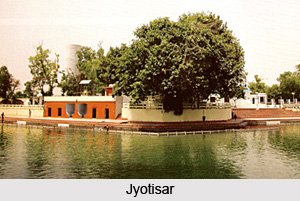
Jyotisar: One of the most revered of holy centers of Kurukshetra is Jyotisar. It retains its sanctity as the birthplace of holy Bhagavad Gita. Jyotisar lies on Pehowa road, 5 kms from Kurukshetra.
Moreover, there are about 360 Tirthas of huge religious importance in Kurukshetra District. All these pilgrimage sites are worth seeing and attract visitors from far and wide.
Leisure Tourism in Kurukshetra District
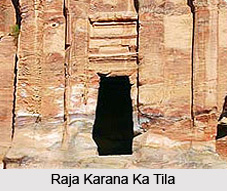 Leisure tourism in Kurukshetra District includes visits to its popular archeological sites. These significant historical places attract the travelers from all parts of the country. The major archaeological sites of Kurukshetra District include Raja Karana Ka Tila, Bhor Saidan, Asthipura, Bhagwanpura and more. Details of these sites are mentioned below -
Raja Karana Ka Tila: It is a small mound located at around 5 kms to the west and south-west of Thanesar. It is about 500 square feet (46.5 square metres) at the top, 800 sq feet (74 square metres) at the base with a height of 30 feet to 40 feet (9 metres to 12 metres). Shreds of Painted Grey Ware and some other objects such as flesh-rubber, a terracotta reel, a mould for printing cloth, human head, a double inkpot, a hollow terracotta rattle, an earthen pot having a line of trisula and wheel carved on it, one earthen pitcher ornamented round the shoulder and some pieces of glazed pottery of the Muslim period have been found here during excavations. There is also a large well of that period.
Asthipura: This historical site lies to the west of Thanesar and marks the place where the bodies of the dead soldiers of the Mahabharata war were said to have been cremated. Cunningham excavated the mound which measures about 700 feet by 500 feet (213 metres by 152 metres) and found an extensive platform of unbaked bricks still 364 feet (111 metres) in length. Besides, remains of walls and fragments of terracotta sculptures have also been found.
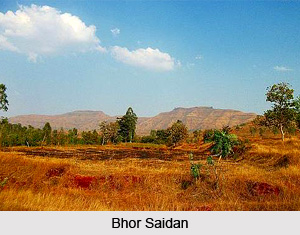 Bhor Saidan: It is a small village in Kurukshetra District. At about 13 kms to the west of Thanesar towards Pehowa lies the Bhurirava Tank. Tradition associates the place with the war of Mahabharata. Bhuri was son of Somadatta, King of Vaishali. The village is named Bhor after him. This small village is situated on an ancient mound.
Bhagwanpura: Bhagwanpura is situated in the north-west of Ladwa on the right bank of the Sarasvati River. It is a prehistoric site which presents an overlap between the late Harappan and the Painted Grey Ware cultures which is of considerable significance, so far as the reconstruction of a continuous history of Haryana is concerned. Continuity on the tradition supported by characteristic finds in pottery type, painted designs, art of terra-cotta figurines and burials provide evidence of the two cultures here. The three phases of the structural activity of the Painted Grey Ware people are represented successively by the round or semi-circular thatched huts followed by, mud-walled houses and then by houses built with baked bricks. Interesting oval-shaped structures meant for some religious functions have also bee discovered.
Daulatpur: Daulatpur is another important archaeological site, situated on Thanesar-Ladwa road near Pipli crossing, where excavations have revealed a relationship between the late phase of the Harappan and Painted Grey Ware cultures.
These archaeological sites offered by Kurukshetra District are worth seeing.