Kathak is regarded as the most prominent dynamic theatre art. The word Kathak has been derived from the word `katha`, which means `the storytelling art`. It has theatrical representation of themes from Urdu and Persian poetry along with some taken from the Hindu mythology. With dance, music and mime these storytellers of ancient India would bring to life the great scriptures and epic of ancient times, especially the great Indian epics, like, the Mahabharata, Ramayana and the Indian Puranas.
History of Kathak
The earliest reference to the art of Kathak is found in Mahabharata, the great epic poem written about five centuries ago. At this early phase the art of Kathak was performed by a group of Brahmins in praise of the lord. Around the 16th century AD, when the royal courts of the Hindu maharajas and the Muslim Nawabs patronized the art, it acquired secular elements and sophistication especially in the pure dance or Nritta aspect. Here Kathak encountered various other dance and music forms, where the dancers were lured from temples in order to perform in courts by presenting those gifts of silver, gold, jewels and other royal favour.
Miniature painting provides revealing evidence of the development of a dance form which resolve itself into the Kathak style ultimately. The beginnings of the style can be traced back to the dance illustrated in Jain paintings and manuscripts specifically the Kalpa Sutra. The dancer is depicted here in the ardhamandali position. In Rajasthani paintings there are illustration of the Dasama skanda of the Bhagvata where Krishna dances with the gopis. There are several other illustrations of Lord Krishna like this. There are thousands of paintings depicting secular dance or the female dancer in either a court or in a garden.
Style and Technique of Kathak
 The technique is characterized by fast rhythmic footsteps, accompanied by music, where the dance movements include numerous pirouettes executed at lightning speed and ending in statuesque poses. Kathak conceives of space only in straight lines. There is only a front-back treatment of space. Pirouettes are executed along a central vertical median from which no shifts take place. The weight of the body initially equally divided and the knees are not flexed. Kathak demands minute foot-work. Kathak dancer places the flat foot forward lightly carrying the body weight along. The alphabet and vocabulary of dance movements are conditioned by the metrical cycles on which rhythmic variations can be implemented.
Costumes of Kathak
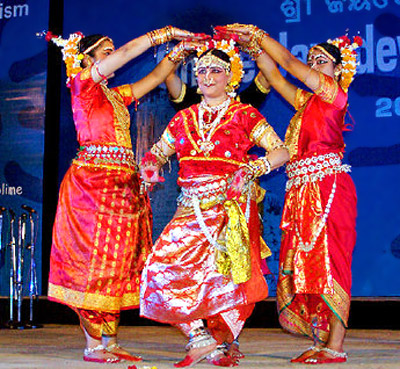
The Kathak female dancers wear a Ghaghara, a choli and a veil. For the men, the costume includes Dhoti-Kurta or Kameez-Churidar-Vest. Gold and silver ornaments are used for head, neck, arms, hands fingers, waist and feet. Ankle bells are also an essential part of adornment. The tinkling bells not only heighten the movement of the dancing foot and helps in dancing many complex patterns and designs. As per the jewellery, they include: Bangles, Earrings, Hair and Finger ornaments are also used.
In the 16th century tight churidar pyjama appears as a standard dress of Kathak. Even if the dancer wears a full-skirted lehenga, the churidar pyjama below is seen. Prior to the 17th century, the women danced to the beats of the Mridanga and the Manjira. Gradually, there is less inclination to the ardhamandali position and the dancer begins to have a straight and erect posture. The dance could not remain away from the growth and development of north Indian music, specially the khayal. Both the dhrupad and the khayal accompanied the dance. The distinctions between Lasya and Tandava and between Nritta and abhinaya were kept intact in Kathak. This dance-style was given a direction by the Vaishnavite tradition of north India. In the process of making dance an abstract design, the dancer never forgot that it was an invocation to God.
Music in Kathak
 Bansuri, Dilruba, Ghungru, Harmonium, Santoor, Sitar, Tabla and few more instruments accompany the Kathak dance. Maharaj Bindadin and his brother Kalka composed bhajan, thumri and padas. They were written mainly for the Kathak dance and it is apparent from wordings of the writers that they were making words for movements. This dance style makes great use of Hindustani musical compositions which have been entirely composed for the purpose of dance. The Dhamar, Bhajan, Thumri, Tappa, Dadra Kavitha are some of the Hindustani musical compositions. As a lyric, thumri consists only of one Sthayi and an antara. The Dhamar and Hori composition are related to Radha-Krishna legend and Rasa Lila with the gopis, the cowgirls of the Braja -mandala. The hori lyric revolves round the theme of the Holi festival.
Revival of Kathak
Today, this dance form has recovered from the decline, which was caused after the commencement of British Raj, and has gained its fame after the British period and is been recognized as one of the classical forms of dance in India. The contribution of the dancers of Maharaj family including Shambhu Maharaj, Acchan Maharaj, Lachhu Maharaj, Birju Maharaj and so on have been extremely productive in making Kathak popular. Kumudini Lakhia and Birju Maharaj have introduced multi-person choreography, the former using pure classical styles and movements with clearly contemporary space use. The Kathak dance tradition of Lucknow is undoubtedly one of India`s finest cultural achievements. With so many outstanding exponents nationally and internationally it will continue to tell its stories for generations to come.
Indian Kathak Dancers
Kathak Dancers are regarded as storytellers through their superb limb movements and facial expressions. Some of the famous Indian Kathak dancers are Loanna Srinivasan, Shila Mehta, Guru Kundan Lal Gangani, Sudha Chandra Sekhar, Arpita Roy and so on.