 Jwalamukhi is a volcano in the Kangra Valley of the Himalayas. Two fairs are held here in April and October in the honour of Jwalamukhi (blazing visage), the goddess of the volcano.
Jwalamukhi Devi Temple
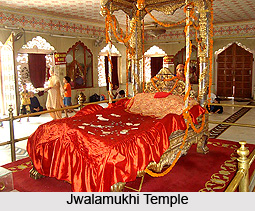
Jwalamukhi Devi Temple, tended by the followers of Goraknath is perched on a ridge called Kali dhar. The picturesque temple, built against a wooded spur, in the Indo-Sikh style, has a dome that was gilded by Mughal Emperor. It is one of the 51 Shaktipeethas of India. The temple of Jwalamukhi is in Jwalamukhi town, which is about 70 kilometres from Dharamsala. Inside is a square pit, three feet deep with a pathway all around. The rock in the middle has a crack, through which a gas is emitted, and on lighting it the gas bursts out into a huge flame, the priest keeps applying the flame to the gas - which is seen as a blessing of the deity. There is no idol in this picturesquely located temple and the flame is considered a manifestation of the Goddess.
Mythology of Jwalamukhi Fair
The people of the hilly areas believe that the inflammable gases from the volcano are instead the sacred fire coming out from the Goddess of the Jwalamukhi volcano and hence they worship this Goddess in April and October, every year. According to ancient legends, when the demons were harassing the Himalaya Mountains, the gods, led by Lord Vishnu, decided to destroy them. It was at that time that huge flames rose from the ground where they focused their strengths. And from that fire, a young girl took birth, which is regarded as Adishakti-the first `shakti`. Thus, a popular centre of pilgrimage for several centuries now, the temple of Jwalamukhi is considered amongst the most sacred in northern India.
According to another legend Prajapati Daksha, the father of Sati organized a great Yajna and invited all gods except Shiva. When Sati came to know of this, she insisted Shiva to go to the Yajna. Shiva maintained that they should not go uninvited. Shiva did not agree for himself but allowed Sati to go. On reaching her father"s house, Sati saw that no seat (asan) had been earmarked for Shiva, which meant a deliberate attempt to humiliate Shiva. She was so offended that she at once plunged herself into the havankund of Yajna. On hearing this, Shiva rushed to the spot and found Sati half burnt. Distressed Shiva carried the corpse of Sati, spinning it from all the peaks.
Apprehending a great calamity befall, the gods ran to Lord Vishnu for help who then severed Sati`s body into pieces with his Sudarshan Chakra. Across the land where the pieces of body are regarded to be fallen, have risen fifty-one Shaktipeethas, the centres where the power of goddess is inherited. Devi`s tongue fell here and is located near Jullundher in Punjab. The Devi appears in the form of nine different flames. The principal one is believed to be Mahakali. The other eight flames at different places in the temple represent the following Goddesses Annapurna, Chandi, Hing Laj, Vindhya Vasini, Maha Lakshmi, Maha Sarswati, Ambika and Anjana.
Attractions of Jwalamukhi Fair
In princely times, temple affairs were guided and supervised by the princely state of Nadaun. In 1809, Maharaja Ranjit Singh visited the temple and after dyeing his hand in saffron, stamped an agreement in the temple premises with Raja Sansar Chand-the local ruler. Later, after tasting success in the Afghan war, Maharaja Ranjit Singh gilded the roof of the Jwalamukhi temple as a thanksgiving. His son Kharak Singh presented to the temple a pair of silver-plated folding doors. During the Mughal period, a fervent devotee from Delhi, Dhianu Bhagat visited the temple, along with several others. Emperor Akbar, his curiosity aroused at such an exodus from his capital, followed Bhagat. He tried to put the flames out but failed. Later Akbar visited the temple with Jodha Bai and presented a solid gold umbrella to the shrine, which can be seen even to this day. The King of Nepal presented a magnificent bell, which adorns the front hall.
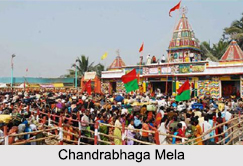
During the fair, milk and water is offered to the flames, the `puja` goes on for the whole day. People come with red silken flags (dhwaja) to greet the Mother Goddess. The fair is attributed to the worship of that Eternal Flame which is coming out of earth spontaneously and perpetually. People flock to the temple dedicated to Goddess Jwalamukhi and take holy dips in the neighbouring hot springs. Pilgrims bathe in the warm waters of the hot springs at Jwalamukhi. Then the deity is offered Bhog of Rabri or thickened milk, Misri or candy, seasonal fruits and milk. The puja has different `phases` and goes on practically the whole day. Arti is done five times in the day, Havan is performed once daily and portions of "Durga Saptasati" are recited.