Indian Theatre initiated as a narrative form. The art of reciting, dancing and singing gradually became an integral element of Indian theatre whilst boasting its copious tradition. Indian theatre is essentially narrative. This emphasis on narrative elements made Indian theatre theatrical right from the remote past of the heydays of Sanskrit theatre. This is perhaps the reason why Indian theatre has so very well encompassed all the popular expression of literature and fine arts into its physical manifestation. Indian theatre, pregnant with its rich past has therefore amalgamated the richness of literature, mime, dance, music, painting, architecture and sculpture to carve a niche for itself in the arena of entertainment.
The history of Indian theatre goes back to more than 5000 years. Natyashastra, written by Bharat Muni was the ancient treatise on Indian theatre. Theatre in India started as a narrative form such as singing, dancing and reciting. Once started as just a narrative form, Indian theatre gradually developed to be an independent form of expression. The development of Indian theatre can be divided in three parts namely, Theatre in ancient India, Theatre in medieval India and Contemporary Indian Theatre. The journey of Indian theatre is therefore the chronicle of changing traditions in India which still echoes the changing pattern of Indian natya.
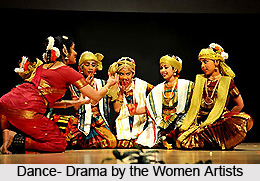
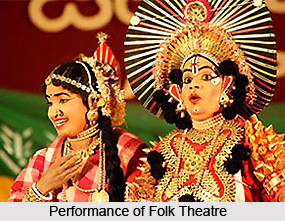
Indian theatre has a deep rooted relation with Indian epics and Indian mythologies and has thus witnessed the change in tradition. The forms of Indian theatre are therefore varied and can be broadly classified into six different genres like Classical Indian dance drama, traditional Indian theatre, Indian Folk Theatre, Indian Puppet theatre, Modern Indian theatre and the Indian Street Theatre. Forms may differ, yet every form of Indian Theatre carries the essence of the rich cultures and mores of India
 Eminent personalities in Indian theatre made theatre in India not only an art form but slowly crafted it as the refined technique of illustrating the unedited realities of life in the form of "Rupaka" and "Natya". Theatre, which was once just a medium of expression gradually broke the barrier of mythology, history and eposes and became a weapon to protest. The echo of the age old Sanskrit plays faded away, Indian Classical dance drama style gradually modernized; and developed a new form of expression- Indian drama. Dance, instrumental music, speech furnished on lyrics, verses and prose then laced the Indian Theatre whilst making it an expression of the creative minds.
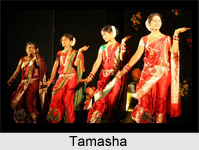
Indian theatre gained a dimension with the introduction of the regional theatres. India`s multilingual aspect gained a platform of expression through the regional theatres in India. Different religion, various culture and varieties of Indian languages have played a significant role in building up the rich tradition and heritage of the regional Indian theatre. India can not be united to one particular kind of trend and expression in its theatres and dramas. And may be because of this reason it can be said that the fervency of Bengali theatre has set well with the warmth of Hindi theatre, Malayalam theatre, Gujarati theatre, Kannada theatre and Marathi theatre. The amalgamation of all these has given birth to a whole new concept of `Indian Theatre`.
The major production of Indian theatre further silhouetted Indian theatre to a great extent. Famous plays created and acted by great theatre personalities were a treat to the audience. There were mythological dramas which were different from the historical drama of nineteenth century. Radio Drama came just after that in the twentieth century. Famous productions in Indian theatre did occur during and after the British Rule. Theatre was then the weapon of protest against British colonialism and quite ideally therefore all the major productions in Indian theatre portrayed the pain, agony and frustration of the common people during the British Raj. Theatre was then just not a media for entertainment but was lot more. The Major productions in Indian theatre after independence further became the exemplifications of the socio-political and economic conditions of independent India. The leftist movement, the political scenario, the burning questions of unemployment all found an answer in the varied productions of Indian theatre after independence.

Major theatre groups and companies were formed during this time which further aided in making Indian theatre to carve a niche for itself. In the year 1943, Indian People`s theatre Association was formed which was a pre-eminent activist institution formed as an all Indian organization in Mumbai. Theatre which began as just an art form gradually stood apart as an emblematic form of artistic expression. Theatre in India during and after the independence of India became an artistic illustration of the tradition and heritage of India.
Indian drama and theatre, considered even older than its music and dance, possesses classical theatrical traditions, which have also influenced modern theatre, especially the Hindi, Marathi and Bengali plays. The modern Indian theatre started to grow more in the 1850s as the theatre enthusiasts started to perform their own play on different languages which were based on western style. . This new hybrid form of Indian theatre turned to a ticketed theatre in the 1870s as it slipped from the hands of the riches. At the end of the 19th century, this modern form of Indian theatre became the source of earning of bread and butter to many. It moved to the hands of common public and turned into a commercial unit.
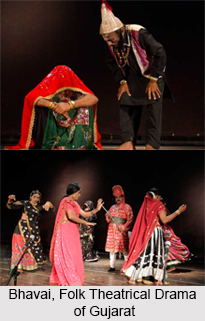
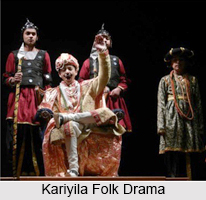
The legacy of Indian theatre is rich pregnant with a copious past. The tradition of folk theatre is alive in almost all the linguistic regions of the country. In addition, there also exists a rich tradition of puppet theatre in rural India.
More on Indian theatre
History of Sanskrit Theatre, Nataka, One-act drama, group theatre, history of India drama, Nautanki, Mukabhinaya, Indian Puppet Theatre, Shadow Puppet, Sangeet Natak Academy
More On Forms Of Indian Theatre
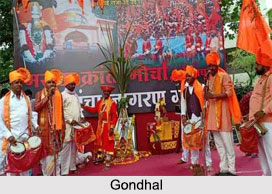
Ramlila, Raslila, Bayatala, tiatr, Bhaoriya, Bharat Lila, Bhramyaman Mancha, Dasavatar, Gambhira, Gombeyata, Gondhal, Harikatha, Kabigan, Kalsutri Bahulya, Galihyun, Kurattiyattam, Mach, Mutiyettu, Nondi Natakam, Palagan, Pandavani, Jatra, Prahlada Nataka, Porattu Natakam, Prahasana, Prakarana, Ravana Chhaya, Sangitanataka, Sakhi-kundhei Nata, Sattaka, Shumang Lila, Suanga, Chhau, Swang, Talamaddale, Bhana, Tanatu Natakavedi, Terukkuttu, Anganmancha, Uparupaka, Utsrishtikamka, Vilasam, Villuppattu, Vithi, Voggukatha, Vritti, Vyayog, Rupaka, Das Rupaka, Sanghakali, Natika,
More On Indian Theatre Personalities
Bhasa, Kalidasa, Sudraka , Dinabandhu Mitra, Michael Madhusudan Dutta, Rabindranath Tagore, Jyotirindranath Tagore, Utpal Dutta, Girish Kannad, Safdar Hashmi, B.V. Karnath, Shambhu Mitra,Vijay Tendulkar
More On Indian Theatre Groups and companies
D. J. Sindh College Amateur Dramatic Society, Darpana Academy of performing arts, Desi natak Samaj, Janata theatre, Sri Pratap College Dramatic Club, Elphinstone Dramatic Club, Amateur Dramatic Association, Manipur Dramatic Union, Grant Road Theatre, Gujarati Natak Mandali, Morbi Arya Subodh Natak Mandali, Praja Natya Mandali, Indian National Theatre, Boys` Companies, Rupmahal Theatre, Surabhi Theatre, Tibetan Institute of performing Arts, Victoria Theatrical Company, Praja Natya Mandali, Natmandal. Telugu little theatre