 Haj is pilgrimage to Mecca. Haj is mentioned in the Hadith (traditions) and it is the fifth of the Arkan or Pillars of Islam. Haj is also an imperative duty (Fardh) for all Muslims who have the resources to carry it out and a compulsory pilgrimage to be performed once in a lifetime. However, one may perform it more than once. Haj is an ibadah in which money is spent in Allah`s way and strength is sacrificed for the pleasure of Allah. At the same time, it is a test of patience. Haj also provides Muslims from all parts of the world an opportunity to meet at a central venue to strengthen the bonds of Muslim Brotherhood. Haj starts on the eighth day of the Zul Hijjah or Dhu al-hijah, the twelfth month of Muslim year. One can send a proxy, if he is unable to perform the Haj. The one who completes the Haj is called Haji.
Pilgrims of Haj
About three million pilgrims leave for Mecca during this month. Pilgrims travel to Mecca in groups with their friends or family, or people from their local mosque in order to save money. A woman is permitted to go to Mecca only in the company of a male relative (father, husband, or brother). The Saudi government permits an unaccompanied woman to go, provided, she travels in a group with other women and has written permission to do so from a male relative (even if the relative is not a Muslim or is younger than she is).
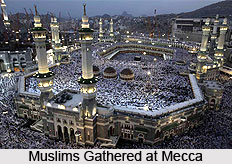 Five Days of Haj
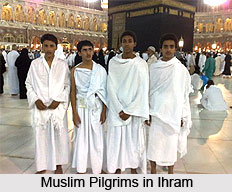
On the first day of Haj, `Ihram` is put on by the pilgrims. `Ihram` or pilgrim`s dress in Islam symbolizes leaving behind the material world and entering into a state of godliness or spirituality. It is made of two plain unstitched lengths of cloth. Most Muslims wear these clothes during Haj. Many female pilgrims wear a simple white or black dress with a head covering. Ihram is symbolic of the equality between the believers of Allah. An invocation called Talbiyah is chanted when a pilgrim dresses himself in Ihram in the Miqat (a place provided to change into ihram). After changing into Ihram, pilgrims leave for the nearby town of Mina.
On the second day of Haj, pilgrims assemble in the plains of Arafat. Here, a pilgrim thinks of the Doomsday or the Judgment day by Almighty, when he shall have to account for the deeds he committed in this world. The stay at Arafat is called "Wuquf." At night, they collect stones at Mujdalif, a place between Arafat and Mina.
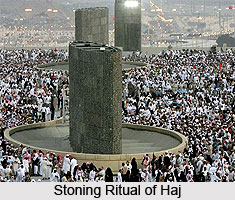 On the third day, pilgrims return to Mina. This day is called Eid-ul-Adha. Pilgrims throw seven of the collected stones at the pillars of Jamarat. This act confirms symbolically, that they will chase away Satan. On this day, they sacrifice an animal and pledge to detach themselves from the worldly attractions. On this day, pilgrims are not bound by the restrictions of ihram. They can shave their heads and can change out of the ihram garment. The head shaving is a symbol of rebirth, signifying that the pilgrim`s sins have been cleansed by completion of the Haj. On this day or the following day, the pilgrims visit the Masjid-al-Haram in Mecca for a tawaf called the Tawaf-az-Ziyarah (Tawaf al-Ifadah), which is an obligatory part of the Haj. Tawaf is walking around the Kaaba (holy house of Mecca) four times, at a hurried pace. Three more rounds in a counter-clockwise direction follow this, more closely and at a leisurely pace.
On the afternoon of the fourth day (the 11th of the month), pilgrims must stone all three pillars at Jamarat in Mina. The same ritual is performed on the following day. Here, the pilgrims must perform the stoning ritual again on the sixth day, if they are unable to leave Mina before sunset on the fifth day of Haj. Haj teaches complete devotion to the Almighty. It teaches one to use his thoughts, words and deeds in service of Allah. Haj is a complete and compact form of worship in the performance of which one learns about the spiritually vital aspects of life. However, only those who perform Haj in its true spirit can experience these benefits.