


 Folk dance of Tamil Nadu has both regional autonomy and features that are truly of that particular state. Tamil Nadu had developed the art of entertainment to its pristine heights at a very early age. The folk dances of Tamil Nadu have survived through many centuries of Indian History and have provided continuity to the Indian tradition that is not stagnant, as it is constantly adapting itself to new conditions and assimilating influences. Folk dance of Tamil Nadu has both regional autonomy and features that are truly of that particular state. Tamil Nadu had developed the art of entertainment to its pristine heights at a very early age. The folk dances of Tamil Nadu have survived through many centuries of Indian History and have provided continuity to the Indian tradition that is not stagnant, as it is constantly adapting itself to new conditions and assimilating influences.
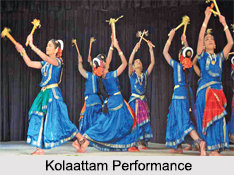
Various Folk Dances of Tamil Nadu There are several folk dances of Tamil Nadu which have been bearing the culture and tradition of the state. The most popular folk dances are Kuravanji, Karagattam, Kummi, Kollattam, Kavadi Attam, Nondi Natakam, Pavai Koothu, Kai Silambattam, Mayil Attam, Oyilattam, Devarattam, Dummy Horse, Peacock Dance etc. Below the folk dances are detailed: Karagattam: This is a kind of folk dance which is performed with balancing pot on head. The villagers perform this dance in praise of the rain goddess "Mari Amman" and the river goddess "Gangai Amman" as a part of their custom. Kummi: It is the most important folk dance of Tamil Nadu. This dance form is performed by the women folk. This form is performed with no assistance of musical instruments but with the clapping. This dance is usually performed during temple festival. Kolaattam: Kolaattam is an ancient village art. This is performed by women only, with two sticks held in each hand, which is beaten to make a rhythmic noise. Pinnal Kolaattam is danced with ropes which the women hold in their hands, the other of which are tied to a tall pole. With planned steps, the women skip over each other, which form intricate lace-like patterns in the ropes. This is performed for ten days, starting with the Amavasi or Newmoon night after Deepavali.
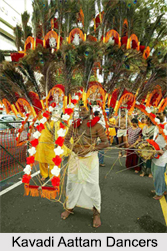 Kavadi Aattam: This folk dance of Tamil Nadu is performed during the full moon day of the month Pusam. Mythology states that on this day Goddess Parvati gave a spear to her son Lord Karthik to vanquish the devil Surapadman. A kavadi is a weight carried on the shoulders and made of crossbars of bamboo or a cane with weights. This kavadi represents the burden of life that is assuaged by seeking the Lord’s help. In ancient days, the kavadi was carried as a part of the offering to the Lord. Only men are allowed to carry the kavadi and devotional songs of Lord Karthik are played to mitigate the boredom of long travel.
Kai Silambattam: This folk dance of Tamil Nadu is performed in temples during Amman festival or Navaratri festival. The dancers wear ankle-bells and hold anklets or silambu in their hands, which make noise when they are shaken. They perform various stepping styles. The dance is in praise of all female deities, especially Goddess Kali and Durga. Mayil Attam: Mayil means peacock in Tamil language. This dance form is performed by rural women. They dress in the vivacious colours of the peacock with its feathers, a glittering head-dress with a beak. The beak can be pulled open and then close by a thread by the dancer. Also a wooden tail is attached to the dancer to give a realistic resemblance to the peacock. This form of dance requires extensive practice and pure zeal. The tail, beak and the feathers are movable and its movements form an important part of the dance. This dance is performed to praise Lord Subramaniya whose vahana is the peacock. This folk dance of Tamil Nadu is basically executed in temples. Oyilattam: Oyilattam folk dance of Tamil Nadu is performed by men to narrate the mythological stories of Lord Subramaniya and his wife Valli. The word Oyil means beauty. This dance is performed during temple festivals. There is no musical instrument involved other than a set of bells worn around the anklets. This dance form varies from place to place. In one type of this form, dancers with anklets dance rhythmically to the music. Soon many other dancers join the earlier set of dancers and sway according to the rhythm and complete the dance. This dance is also performed during the harvest season, New Year and other important festivals. Devarattam: Devarattam is a pure folk dance of Tamil Nadu, which is still preserved by the descendents of Veerapandiya Kattabomman dynasty at Kodangipatti of Madurai District. It was actually performed once a year near the temple and that too restricted to that community alone. Folklore research scholars have found that Devarattam is a combination of ancient ‘muntherkuruvai’ and ‘pintherkuruvai’ of the ancient Tamil Kings. It was performed in front of the chariot on the victorious return of the King and his army from battle field. Poikkal Kudirai Aattam: This folk dance of Tamil Nadu is mainly known as dummy horse. In this dance form, dancers bear the dummy figure of a horse’s body on his/ her hips; this is made of light- weighted materials. The dancers don wooden legs which sound like the hooves of the horse. The dancer brandishes either a sword or a whip. This folk dance needs much training and skill. This dance is accompanied by Naiyandi Melam or Band music. This is connected to the worship of Ayyanar, which prevails mainly around Thanjavur. 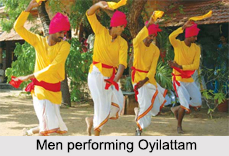 Bhagavatha Nandanam: This folk dance form depicts the life and glory of Lord Vishnu in his various avatars. It is a dance drama performed at Narasimha Jayanthi and also during Gokulastami or Ramnavami.
Kuravanji: Also known as Kuravanji Medai, Kuravanji is a blend of dance and melody distinct to the folk culture of Tamil Nadu. Often considered as a dance drama, Kuravanji is an art form that traces it origin to the era of King Rajaraja Chola. A blend of folk and classical dance, Kuravanji was originally performed by Devadasis in temples and they were called Kuravanjis. Nondi Natakam: Dating back to the 17 century, this folk dance drama uses simple language and endearing music as a means of folk entertainment. Nondi Natakam narrates the experiences of a one-legged thief, from his falling in love to obtaining salvation through devotion to God. Karagam: In this form of folk dance, villagers honor the rain Goddess Mariamman and the river Goddess Gangaiamman. Folk music created by drums and long flutes accompany this dance form. Bamber: This is a dance form is performed inside a temple is praise of Lord Krishna. It is mainly performed around a lamp on festivals like Ram Navami and Gokulashtami. Kazhai Kothu: This dance form showcases incredible balancing arts and also includes gymnastics steps. People performing this folk dance use gaudy makeup and costumes. Kazhai Kothu traces its origin from Aryans. Ottan Koothu: This folk dance is mainly performed by tribal people during festivals to narrate ancient stories through art form. An instrument named Urumi is played during the performance which is believed to have sacred and supernatural powers. Paampu Attam or Snake Dance: This folk dance form is performed by young girls wearing tight-fitted costumes, resembling a snake. The signature dance moves like raising their hands on their head, slithering, creeping and hissing are similar to movements of snakes. This dance form conveys the message of protecting snakes and accepting them as divine creatures. Poikkal Kuthirai Aattam: Also known as artificial horse dance, this folk dance is performed along with folk music to worship Goddess Amman. Dancers wear a dummy horse which is hollow in the centre so that it can be worn like a costume. The horse’s body is made of colourful light-weight material to make the movements easy for dancers. Puliyattam: This old folk art dance is also called tiger because dancers paint their bodies in yellow and black paint to create a replica of Tiger. The look is completed by joining a fake tail and a pair of ears. Drums and other musical instruments are played to accompany the dance where dancers sway in graceful tiger-like moves. Shattam Dance: Dedicated in worship of Lord Vishnu, this dance form is performed in groups with folk instruments like Urumi. Classical songs and graceful steps are its main features. Koothu or Theru Koothu: It is a street art form in which music and dance are performed by people. Koothu is a performed at a meeting point of three to four streets in an open ground, usually during festivals and weddings. Men both and women take part in it. Chakkai Attam: It is one of the popular folk dances of Tamil Nadu where eight to ten dancers stand in a circle or parallel lines to perform and art form. They hold teak wooden pieces between their fingers to create sound as natural background music. The art form is dedicated to worship Gods and Goddesses. Poi Kal Attam: In this folk dance, the dancers wear false legs during the entire performance. The false legs are tied with wooden sticks which are covered by the dance costume. This makes the dancers look taller. Parai Attam: This traditional dance involves parai, a rhythmic beat instrument whose music captivates the audience. The dance steps are subtle and often replicate war moves. Urumi Attam: As the name suggests, this dance is performed in accompaniment with the folk musical instrument “Urmi”. The strong beats of Thappu, which is another folk instrument provides the rhythm. Urumi Attam is a temple dance form performed especially in Amman temples during the month of Adi. |
| |||



Folk Dance of Tamil Nadu
| The traditional and cultural values of Tamil Nadu are reflected in their folk dance. The state has both features and regional autonomy authentic to itself. The folk dances are there since a long time and have made an important cultural representation all around the globe. |
| ||||||||||||||||||||||||||||

