


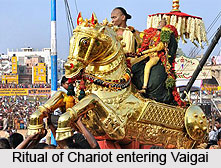
 Chithirai Thiruvizha is an important regional festival which is celebrated with great pomp in Madurai, the state of Tamil Nadu, particularly in April which corresponds to 'Chitirai', the Tamil month. It is believed to be amongst the lengthiest celebrations in the entire world and continues for a month. The initial 15 days of Chithirai Thiruvizha is observed to honour 'Meenakshi' or Goddess Parvati while the remaining 15 days are spent in the memory of Alagar or Lord Mahavishnu. Chithirai Thiruvizha is an important regional festival which is celebrated with great pomp in Madurai, the state of Tamil Nadu, particularly in April which corresponds to 'Chitirai', the Tamil month. It is believed to be amongst the lengthiest celebrations in the entire world and continues for a month. The initial 15 days of Chithirai Thiruvizha is observed to honour 'Meenakshi' or Goddess Parvati while the remaining 15 days are spent in the memory of Alagar or Lord Mahavishnu.
There exists a legendary tale associated to this festival according to which Lord Vishnu or Alagar was unable to reach the venue of his sister Meenakshi's marriage with Lord Shiva in time. Alagar is located about 20 kms away from Madurai city. Since Alagar had to cross a dense jungle from Alagar Hills he disguised himself as a robber. Alagar, however reached Vaigai River one day late and his sister's wedding had already taken place by that time. When he learnt that Lord Shiva had already married his sister in his absence, Alagar was furious and immediately Meenakshi and her husband Shiva approached Him there, and explained the circumstances to the former. Thereafter, Alagar offered the wedding gifts to Lord Shiva and Meenakshi, inside a 'mandabam' or a small building at the central part of Vaigai River and left for Alagar Hill, refusing to enter Madurai. Mythological History of Chithirai Thiruvizha 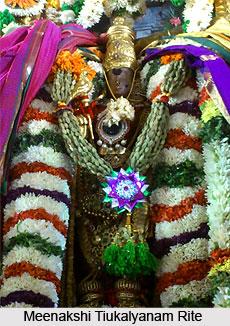 As per historical accounts, the Meenakshi Festival and Alagar Festival are two distinct festive events, each of them observed in a different month and commemorating separate occasions. Meenakshi was the daughter of Malayathuvaja Pandian, a Pandian ruler and his queen Kanchanamalai who had appeared before the king while he was offering special Pujas to please the Gods as he did not possess a child for a long time. A holy voice from the heavens told them that their daughter was an earthly incarnation of 'Shakti', implying she was once Lord Shiva's wife and that Shiva would marry her at the appropriate time. Meenakshi emerged a powerful warrior and was crowned as the queen of Pandian kingdom, after which she invaded the entire world, armed with her outstanding battle skills. Finally she reached the abode of Lord Shiva, which is 'Kailasam' where she was attracted to Lord Shiva at the battlefield and discovered that She was an avatar of Shakti. Lord Shiva married Meenakshi after arriving in the Pandyan kingdom with the saints and 'Devas'. He then ruled over the empire as Sundara Pandyan. The Shaivites celebrate the festival.
The Alagar Festival is celebrated by the followers of Lord Vishnu or the 'Vaishnavites'. The legend states that once a saint named Mandooka Rishi was bathing in Aagaayaganga River in Alagar Hills and during this time Durvasa Maharishi was passing by that spot who was known for his ill tempers and curses. Mandooka Rishi failed to notice Durvasa Rishi, but Durvasa took it as an insult. Infuriated, he cursed Mandooka to live the rest of his life as a frog and reside in Vaigai River, upon which Mandooka requested him to relieve him of the curse. Durvasa Rishi replied that his human body would be restored to him only if he prayed to Lord Alagar. Mandooka was transformed into a frog and he went to Vaigai River and prayed to Lord Alagar to help him. Lord Alagar was content and relieved Mandooka of his curse, and also displayed all His avatars, fulfilling Mandooka's wish. Both the festivals were observed as a single festival during the regime of the king Thirumalai Nayakar. From that time onwards it is celebrated as one festive event and is recognized as Chitirai Tiruvizha. Rituals of Chithirai Thiruvizha During Chithirai Thiruvizha, the sacred flag of 'Kodi Maram' is hoisted in the Meenakshi Ammam Temple by its chief priest which proclaims the commencement of the long festival. It is allowed to fly till the festival concludes. 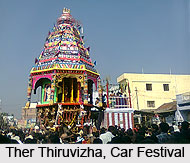 It is called 'Koli Yetram'. 'Pattabisekam' is the divine coronation rite of Meenakshi to mark her crowning as the queen of Madurai and when she conquered the whole world it is known as 'Dikvijayam'. However, immediately afterwards she had travelled to Kailasam and fell in love with Lord Shiva. The grand wedding between Meenakshi and Lord Shiva is termed as 'Meenakshi Tiukalyanam' and the tradition is religiously maintained even till present day. The following day is observed to commemorate the 'Car Festival' or 'Ther Thiruvizha', wherein Lord Shiva and His newly wedded wife Meenakshi visits their subjects, wandering across the streets of their kingdom in a beautifully adorned chariot which is a wooden structure. Innumerable people assemble at the streets of Madurai to pull the holy chariot and be a part of this celebration. On the fourth day of the festival is celebrated the 'Ethir Sevai' during which Alagar is said to visit Madurai and he is worshipped by the citizens. The 'Alagar Vaigai Elenthuarulal' festival is observed after this, when Alagar returns to Alagarkovil after giving the gifts to Meenakshi and Lord Shiva. It is called 'Koli Yetram'. 'Pattabisekam' is the divine coronation rite of Meenakshi to mark her crowning as the queen of Madurai and when she conquered the whole world it is known as 'Dikvijayam'. However, immediately afterwards she had travelled to Kailasam and fell in love with Lord Shiva. The grand wedding between Meenakshi and Lord Shiva is termed as 'Meenakshi Tiukalyanam' and the tradition is religiously maintained even till present day. The following day is observed to commemorate the 'Car Festival' or 'Ther Thiruvizha', wherein Lord Shiva and His newly wedded wife Meenakshi visits their subjects, wandering across the streets of their kingdom in a beautifully adorned chariot which is a wooden structure. Innumerable people assemble at the streets of Madurai to pull the holy chariot and be a part of this celebration. On the fourth day of the festival is celebrated the 'Ethir Sevai' during which Alagar is said to visit Madurai and he is worshipped by the citizens. The 'Alagar Vaigai Elenthuarulal' festival is observed after this, when Alagar returns to Alagarkovil after giving the gifts to Meenakshi and Lord Shiva.
|
| |||



Home > Art & Culture > Indian Festivals > Indian Regional Festivals > Festivals of Tamil Nadu > Chithirai Thiruvizha
Chithirai Thiruvizha
| Chithirai Thiruvizha, Tamil Nadu is celebrated in April in the Tamil month of Chitirai in reverence of Parvati and Lord Shiva as well as to honour Lord Vishnu or Alagar. The festival is associated to some legendary tales and continues for an entire month. |
| ||||||||||||||||||||||||||||

