
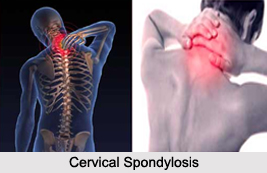
 Cervical Spondylosis is also called "Cervical Osteoarthritis" and is a disorder of cervical vertebrae. It is often the result of degenerative disk disease and it occurs when one vertebra slips slightly forward over another vertebra. It is a condition wherein the vertebral column is compressed and the flow of energy gets restricted in the nerves at the cervical or the neck region, which later penetrates in the lower areas of the body causing pain and discomfort. The displaced bone may pinch the sciatic nerve where it leaves the spine. This is one of the most common ailments. Cervical Spondylosis usually occurs in middle-aged and elderly people.
The cervical (neck) spine is made up of small circular bones, seven cervical vertebrae. These vertebrae are arranged one over another, having a particular gap between each of them. In some conditions like ageing, injuries, any disease related to bones and in the condition of wear or growing of bones the distance or gap between these vertebrae becomes abnormal. Consequently the nerves passing, through that region get pressurized, giving rise to the symptoms of this disease.
Cervical Spondylosis
Cervical Spondylosis is one of the most common types of spondylosis.
Introduction
Symptoms of Cervical Spondylosis
Causes of Cervical Spondylosis
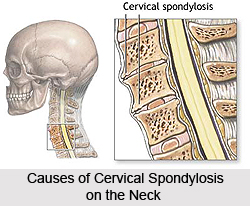 Cervical spondylosis is a disorder which is caused by abnormal wear on the cartilage and bones of the neck. The bones of the neck are called cervical vertebrae. The cushions between the vertebrae are called cervical disks. This disorder is caused normally at the old age associated with degeneration and mineral deposits in the cushions between the vertebrae. The spine is made up of vertebrae, discs, and nerves. Vertebrae are the ridge-shaped sections of bone that make up the structure of the spine, and protect the nerves. The vertebrae are supported and cushioned by discs of cartilage. Cartilage is a type of tissue that is tough and flexible. Causes of Cervical Spondylosis are many; however the common cause is age-related. When a person attains old age, the wear and tear on the cartilage and bones of the neck leads to cervical spondylosis.
As one gets older, the cartilage inside the disks becomes harder and more brittle and provides less support to the vertebrae resting on the disk. This causes the spine to become less stable. The body thus tries and compensate for this by producing small lumps of extra bone to support neck and stiffen the spine. These lumps of extra bone are known as bone spurs or osteophytes. They can cause the spine to become too rigid leading to the symptoms of stiffness and neck pain.
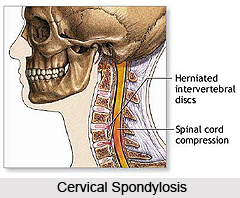
The abnormal wear on the cartilage and bones of the neck can gradually compress one or more of the nerve roots. When nerve roots get compressed, pain in the neck and arm, weakness, and changes in sensation occurs. When, cervical spondylosis reaches its advanced stage, the spinal cord becomes compressed and this compressed spinal cord leads to the pain, weakness and changes in sensation also occur in the legs. Furthermore, Causes of Cervical Spondylosis can be the changes in bone structure that can then compress nearby nerves and blood vessels. The symptoms are widespread pain, difficulties swallowing, and sudden fainting. Cervical spondylosis is caused by chronic degeneration of the cervical spine, the cushions between the neck vertebrae, and joints between the bones of the cervical spine. Other causes include a previous neck injury, bad sitting or standing posture, body type as well as occupational strain.
Previous injury of the body can be among the Causes of Cervical Spondylosis. An individual who have encountered repeated fractures or dislocations of the joints of neck can have cervical spondylosis. The frequent injuries of the neck cause abnormal tear of joints, ligaments and the structure surrounding the joints. Besides the injuries, incorrect postures also let an individual experience the cervical spondylosis.
Incorrect posture adapted by habit or due to poor skeletal set up in the neck predisposes abnormal tear of the neck joints. Bad sitting and standing posture can be one among the several causes of Cervical Spondylosis. Occupational strain is another reason for cervical spondylosis. The physical discomfort, physical strain, intensity of work and duration of working hours, all contributes to the occupational stress. These take an individual further to cervical spondylosis. In addition to that various styles of activity adapted in daily life can cause strain or tear of the structures of the neck and lead to cervical spondylosis. Cervical Spondylosis can also be a result of awkward positions adapted while sleeping.
Body type of an individual also predisposes cervical spondylosis. Individuals with thick necks and hump at the back or Long backs are more prone to cause strain or tear of the neck tissues leading to spondylosis. Thus, the causes of Cervical Spondylosis are mainly due to drying and loss of elasticity in the spinal and cervical disks, Bulging and sometimes herniation of disks so that disk material protrudes from between two vertebrae and stiffening of the ligaments connecting neck bones and muscles.
Treatment of Cervical Spondylosis
 Cervical Spondylosis can be treated with Ayurveda, Naturopathy, Homeopathy, Yoga and Meditation too.
Treatment of Cervical Spondylosis involves most common method. The patients are recommended with nonsteroidal anti-inflammatory drugs, physical modalities, and lifestyle modifications. Furthermore, surgery is occasionally performed to cure the cervical spondylosis. However, the main aim of treating cervical spondylosis is to relieve pain and prevent any permanent damage to the nerves. Various medications have a vital role in helping the patients from the pain. Medicines like nonsteroidal anti-inflammatory drugs; Codeine as well as Amitriptyline can relieve the pain of the sufferer.
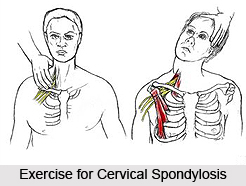
Other modes of Treatment for Cervical Spondylosis include exercises and lifestyle changes. Exercise techniques that strengthen the neck muscles and reduce strain on spine are practised by the patient. In addition to that person suffering from Cervical Spondylosis may also be benefited from taking part in low-impact aerobic exercises such as swimming or walking. Certain lifestyle changes such as using firm pillow at night can reduce the strain on the neck. Conventional treatments also consists of neck brace, neck traction, bed rest, and cortisone injections.
Treatment for Cervical Spondylosis can be through Ayurveda too. Ayurveda which is a natural therapy hence has no side effect or any complications. Ayurveda offers conservative treatment as oral as well as external medication in which herbal medicine helps to reverse the disease-process giving decongestion of the spinal canal and nerve-root bony outlets which can relieve it.
 Alternative medicines for Cervical Spondylosis include homeopathy too. Rhus Tox is one of the homeopathic medicines which is prescribed for relieving pain and stiffness in the neck, pain between the shoulders. Kalmia is for pain from the neck down the arms, pain extending to the shoulder blades, Conium is for cervical spondylosis with giddiness. Other commonly used medicines for treating spondolysis are causticum, calcarea phos, calcarea flour, nux, hypericum,
Treatment of Cervical Spondylosis by Yogic Asanas can provide good results. Asanas such as Bhujangasana, Shalabhasana, Dhanurasana, Supta Vajrasana, Gomukhasana, Ardha Matsyendrasana, Ushtrasana, Matsyasana and Chakrasana are helpful in this disease. Surya Namaskara, Nadi shodhana and Ujjayi pranayama as well as exercises of back and waist described in Sukshma Vyayama also yield special benefit.
Magnetic Therapy also proves to be beneficial for treatment of Cervical Spondylosis. Magnetic therapy offers one of the most effective cures for spondylosis when the damage is caused he inter-vertebral discs and bones. The magnets should be applied to the neck and to the part to which the pain and tingling may radiate. Accordingly, the North Pole should be placed over the most painful point on the neck and the South Pole on the shoulder, elbow or the palm of the left or right hand. South-pole oil should be applied to the site of pair before applying the magnets. All the process of treatment whether its conventional method or alternative medicines, are intended to cure the Cervical Spondylosis and provide relief to the patient.
Recently updated articles in Naturopathy in India
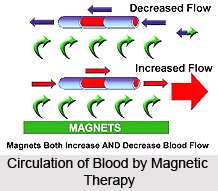
Effect of Magnets on Human Body
Magnets have a stimulating effect on various body systems such as digestive, urinary, respiratory. Magnet has its affect on blood and hence it influen...
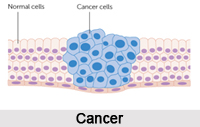
Cancer, Disease
Cancer is a malignant in which a group of cells display uncontrolled growth.
Principles of Massage
Principles of Massage are consisted of proper intricacies and sequence.
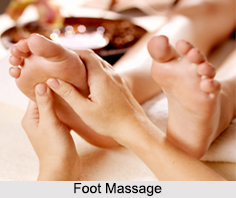
Foot Massage
Foot Massage is an extremely healing and effective therapy in Ayurveda, which can eliminate several problems in the entire body.
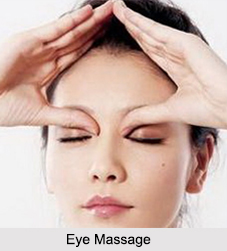
Eye Massage
Eye Massage helps to make the eyes cool and calm making the muscles stronger.
Related articles in Naturopathy in India
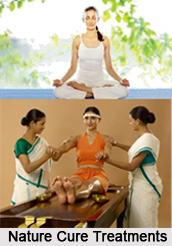
Nature Cure Treatments
Nature Cure Treatments comprise the use of natural elements and healthy lifestyle for healing various ailments and staying fit.

Water Therapy
Water therapy is an alternative therapeutic method that cures many diseases.
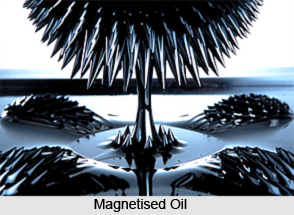
Magnetized Oils
Magnetized Oils are prepared either on the North Pole or the South Pole.