


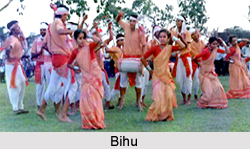
 Bihu is one of the important festivals of Assam. It has little religious significance and is celebrated as a harvest festival. The term Bihu is traced to the Sanskrit word Visuvan; i.e. equinox. The bihus take place on a Sankranti day, which means the time when the sun passes from one zodiac sign to another. There are three Bihus that come off at various stages of cultivation of paddy, the principal crop of Assam. They are Bahag or Rongali Bihu (Baisakh or April), Kati Bihu (Kartika or October- November) and Magh Bihu or Bhogali Bihu (Magha or January). Bihu is one of the important festivals of Assam. It has little religious significance and is celebrated as a harvest festival. The term Bihu is traced to the Sanskrit word Visuvan; i.e. equinox. The bihus take place on a Sankranti day, which means the time when the sun passes from one zodiac sign to another. There are three Bihus that come off at various stages of cultivation of paddy, the principal crop of Assam. They are Bahag or Rongali Bihu (Baisakh or April), Kati Bihu (Kartika or October- November) and Magh Bihu or Bhogali Bihu (Magha or January).
Among the Bihus, spring festival called Bahag Bihu is the most important. The Bahag Bihu is also popularly called Rongali Bihu or the Bihu that cheers, while Magh Bihu is the Bhogali Bihu or the Bihu that one enjoys with food and drink. In between comes the Kati Bihu observed on the last day of Aswin, also called the Kangali or Beggars bihu, for there is nothing much to eat at this time. Pavilions are constructed with thatched roofing of hay where feasts are held at night. The merriments include dances on the wild and lusty beats of Dhol and Pepa (buffalo hornpipe). Songs for this Bihu are woven around themes of love and often carry erotic overtones. People adorn traditional attires like Dhoti, Gamocha and Chadar, Mekhala. In the morning, the pavilions are set on fire. Festivals take place in a communal way, usually in a Namghar or in open space. Bamboo sticks and banana leaves are profusely used and rather than offering cooked food, nutritious food such as sprouted grams and fruits are offered during worship. Buffalo fights form a part of festivities. 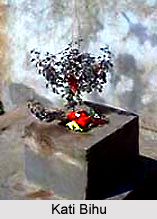 The Bohaag Bihu marks the New Year at the advent of seeding time. It starts on the last day of the month of Chaitra. It is also the day of the Hindu calendar year that ushers in the New Year (mid-April being the beginning of the Hindu calendar year). The first day is called Goru Bihu. It is the day of the cattle when bulls, cows and calves are bathed anointed with turmeric, fed with brinjals and gourds and given new tethering ropes. The second day, i.e. New Year Day is called Manush Bihu. It is the day for men, women and children. New clothes are put on; delicacies are prepared in every household for feasting and alms are given to the indigent. Old quarrels and differences are settled. Friends and relatives are visited and entertained with food. Presents of hand-woven scarves are made for near relations and close friends. It is a great joy for young boys and girls as they court one another on this day. The Bihu continues for seven days. The main activities during the Bihu festival besides those mentioned above, are dancing and singing and serving rice-beer to visitors.
Magh Bihu / Bhogali Bihu Bhogali is derived from the word Bhoga meaning eating or enjoyment. The "Maagh Bihu" marks the end of the harvesting period. People look forward to the coming days without want. It is a harvest festival. On the eve of Bihu day, called "Uruka", i.e. last day of "Puh" ('Pausa') month, women get busy preparing rice cakes and other refreshments. Young men build a temporary shelter in the open; collect firewood, often by stealing, which is permissible on this occasion, for a bonfire. A non-vegetarian feast is held at night. 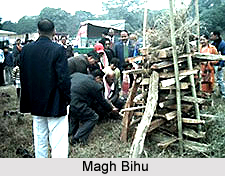 At crack of dawn, fire is ceremoniously applied to the meji constructed the previous evening. The meji is a structure built of logs of wood placed in pairs, tier above tier till they rise to considerable heights and present the appearance of a lofty temple. The male folk of the entire village or locality gather at the site of the meji. A tea party is organised there and cakes of various kinds are served. The feasting is followed by sports throughout the day. The half-burnt sticks and ashes of the meji are strewn on the fields and at the root of the fruit trees, as they are believed to increase fertility.
Kati Bihu / Kangali Bihu Kati Bihu is also called Kangali Bihu (Poor Bihu). It is held on the last day of Aswin (September- October) coinciding with the autumnal equinox. The Kati Bihu marks the completion of sowing and transplanting of paddies. At this time, paddy seedlings begin to grow. There is not much to eat at this time of the year. Accordingly the day is named Kangali Bihu. In the evenings, offerings are made to the 'Tulsi' plant in the courtyard. Little earthen lamps ('Diyas') are lighted at the base of the Tulsi plant, for a whole month. Puja's are offered to God for improved yield of crops. The significance of this Bihu is more in the villages, where farmers go to their respective fields and light "Akash-Banti" or 'sky-lamp' hanging from a tall bamboo, to ward off pests and other insects. Although, Bihu is observed in all parts of Assam, in Goalpara and Kamrup districts of lower Assam and in Darrang district of central Assam (it is also called Domahi here), it is not attended with dancing as in upper Assam. The parallels of Bihu among the races are Baisagu for Bodo Kacharis, Baikhu for Rabhas, Ali- Ai -Ligang for Misings, Bohhaggio Bishu for Deoris. Contemporaries of Magh Bihu are Nara-siga Bihu of Miring, Pushy Par or Tushu Puja of tea tribe of Assam. |
| |||



Home > Art & Culture > Indian Festivals > Indian Regional Festivals > Festivals of Assam > Bihu Festival
Bihu Festival
| Bihu, harvest festival in Assam, take place on a Sankranti day. |
| ||||||||||||||||||||||||||||

