


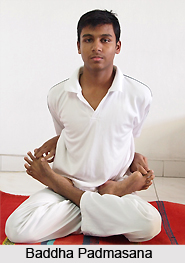
 Baddha Padmasana is a cultural asana derived from a modification of the notable Padmasana. It renders several of the body joints supple and alleviates back and shoulder pain, besides helping to maintain an erect spine and posture. Baddha Padmasana is a cultural asana derived from a modification of the notable Padmasana. It renders several of the body joints supple and alleviates back and shoulder pain, besides helping to maintain an erect spine and posture.
Meaning of Baddha Padmasana Baddha means locked or bound in Sanskrit. This pose is called locked lotus pose, because the limbs of the body, while in Padmasana posture, are firmly locked up and immobilized to enhance its steadiness. In this posture, the big toes are clasped by the fingers, with the arms crossed from behind. Yoga Texts and Baddha Padmasana The Baddha Padmasana is putatively a contemporary variant of the Padmasana. However, texts suggest that the Baddha Padmasana may well be the original posture called Padmasana, while the contemporary Padmasana is derived from the 'bound' form. Both the Hatha Yoga Pradipika (1400 AD) and the Gheranda Samhita (1800 AD) describe postures named Padmasana that are equivalent to the contemporary Baddha Padmasana. The Shiva Samhita, another major Hatha Yoga text, also describes the Padmasana in a fashion similar to the contemporary Baddha Padmasana. However, The Shri Tattva Nidhi, a 19th century text, gives a description of the Padmasana matching the contemporary posture, indicating that it was only by the 19th century or a few decades before, that the modern version began to be practiced. Practice of Baddha Padmasana: 1. Assume the Padmasana posture, placing the feet high on the thighs, close towards the groin. 2. Extend your right arm behind your back and reach round until your right band is near the left hip. 3. Lean forward a little. 4. Twisting the trunk to the right, catch hold of the right big toe, resting on the left thigh firmly with the forefinger and the middle finger. 5. Sit erect and hold the position for a few seconds. 6. Similarly, extend the left arm behind your back and crossing the right forearm, reach round until the left hand is near the right hip. 7. Lean forward a little. 8. Twisting the trunk to the left and bringing the shoulder blades together, catch hold of the left big toe resting on the right thigh firmly with the forefinger and the middle finger. 9. Sit erect and hold the position for a few seconds. 10. The arms and legs are now firmly locked-up. 11. Keep the spine, neck and head erect. 12. Draw in the abdomen. 13. Both knees must press the ground. 14. Look straight ahead. 15. Breathe normally. 16. This is the final position. 17. Maintain this posture motionless for about ten seconds or as long it is comfortable. 18. Release the hands and unlock the foot lock. 19. Stretch out the legs again and assume the normal sitting position. 20. Practice the same, alternating the legs. Effects of Baddha Padmasana 1. The benefits of Padmasana also accrue from Baddha Padmasana and bring greater flexibility to the legs. 2. The stubborn joints of the shoulders, elbows, wrists, lower back, hips, knees, ankles and toes arc well stretched and become more supple. 3. Pain in the shoulders and back is alleviated. 4. It improves the posture by rectifying any unnatural curvature of the spine. 5. The asana increases the range of the shoulder movements 6. This Asana is useful in constipation and improves digestive power. 7. It helps in keeping the spine erect. 8. It is beneficial in Arthritis. Precautions during Baddha Padmasana 1. Practice this asana only after mastering Padmasana as it demands a high degree of skill. 2. Grasp the right big toe with the fingers of the right hand and the left with the fingers of the left hand. 3. Pregnant women must not practice this asana. Mastery in Padmasana is a must before practicing this asana; however just mastery in padmasana doesn't guarantee that you will perfect this asana at your first attempt itself. Those feeling discomfort should not force themselves. |
| |||



Baddha Padmasana
| Baddha Padmasana, or the bound lotus pose, is a variant of the Padmasana or the lotus pose, and alleviates back and shoulder pains. |
| ||||||||||||||||||||||||||||

